
When Connor McDavid suffered a serious knee injury involving a reported PCL tear and tibial plateau fracture, many expected surgery — and a long, uncertain recovery — to be the only path forward. Instead, his comeback became one of the most talked-about examples of elite sports rehabilitation, highlighting the critical role of physiotherapy, movement retraining, strength development, and recovery-focused care. For athletes and active individuals alike, McDavid’s recovery story offers valuable insight into how modern knee injury rehabilitation and strategic massage therapy can help restore stability, performance, and confidence after significant injury.
Why Connor McDavid’s Injury Was So Serious
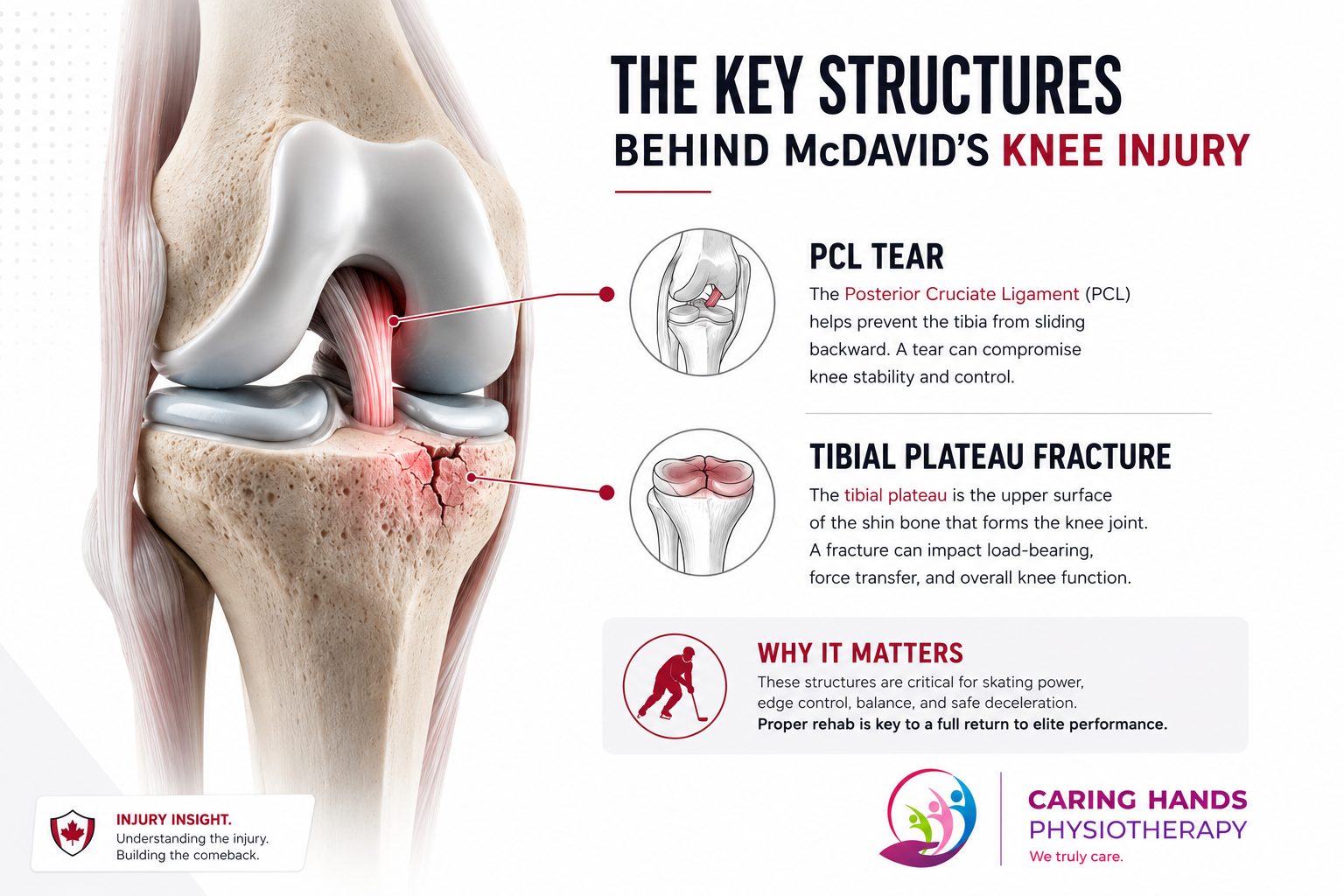
Connor McDavid’s injury was not a minor knee sprain or a routine sports setback. Reports surrounding his recovery pointed toward a combination of a PCL tear and a tibial plateau fracture — two injuries that can significantly impact knee stability, force production, and athletic performance.
For elite hockey players, this type of injury combination is particularly concerning because skating demands:
The posterior cruciate ligament (PCL) plays a critical role in stabilizing the knee by preventing the shin bone from shifting backward excessively. Unlike ACL injuries, which often receive more public attention, PCL injuries can create subtle but significant instability issues that directly affect movement mechanics and power transfer.
At the same time, a tibial plateau fracture involves damage to the load-bearing surface of the knee joint. According to the Cleveland Clinic, tibial plateau fractures can affect joint alignment, weight-bearing tolerance, and long-term knee function — especially in athletes returning to high-demand sports.
For professional athletes, these injuries are not just about pain management. They can affect:
This is one reason many athletes facing similar injuries are often advised to consider surgery, extended recovery timelines, or even modified long-term activity expectations.
What made McDavid’s recovery so remarkable was the ability to rebuild high-level performance through a rehabilitation-focused approach emphasizing:
How Physiotherapy Helped Rebuild Stability and Performance
Recovering from a serious PCL tear and tibial plateau fracture requires far more than rest alone. Elite-level sports rehabilitation is built around carefully progressing movement, restoring stability, rebuilding force production, and retraining the body to handle load safely again.
In Connor McDavid’s case, the rehabilitation process likely focused heavily on restoring:
Modern physiotherapy for knee injuries is typically structured in progressive phases, with each stage designed to protect healing tissues while gradually restoring athletic performance.
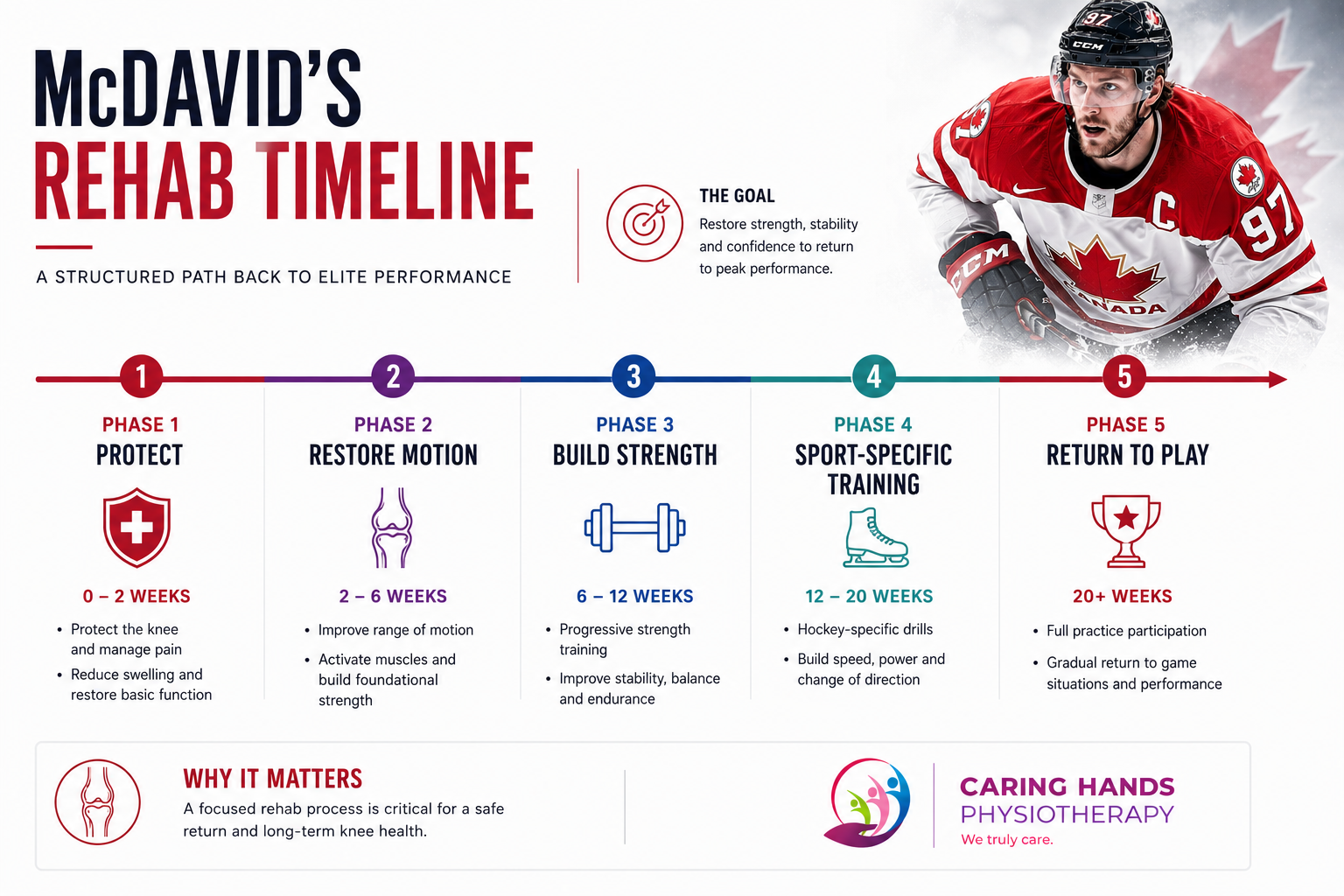
Phase 1: Protection and Joint Preservation
Early rehabilitation focuses on protecting the injured structures while minimizing swelling and maintaining controlled movement.
At this stage, physiotherapy commonly emphasizes:
For PCL-related injuries specifically, rehabilitation often prioritizes quadriceps activation because the quadriceps help support the knee joint and reduce excessive posterior movement of the shin bone.
During this early phase, massage therapy may also support recovery through:
Phase 2: Restoring Mobility and Neuromuscular Control
As healing progresses, rehabilitation typically shifts toward restoring controlled movement patterns and improving neuromuscular coordination.
This phase may include:
For hockey players, this stage becomes particularly important because skating relies heavily on coordinated force transfer, balance, and dynamic knee stability.
Rehabilitation at this level is not simply about strength — it is about retraining how the body moves under speed, force, and fatigue.
Phase 3: Strength Development and Force Production
As athletes progress further into recovery, physiotherapy becomes increasingly focused on rebuilding athletic performance.
This stage often includes:
For elite athletes, restoring confidence in movement is just as important as rebuilding strength itself.
This is where advanced sports physiotherapy and structured rehabilitation programming become critical for returning to high-performance activity safely.
Phase 4: Return to Sport and Performance Reintegration
The final phase of rehabilitation focuses on restoring sport-specific movement patterns and preparing the athlete for full return to competition.
For hockey athletes, this may involve:
At this stage, recovery strategies often continue to include:
The goal is not simply returning to play — it is restoring the ability to perform confidently at an elite level.
Why Massage Therapy Played a Critical Role in Recovery
While physiotherapy is often the foundation of sports injury rehabilitation, recovery-focused massage therapy can also play an important supporting role throughout the rehabilitation process.
For elite athletes recovering from major knee injuries, the goal is not only to heal damaged structures — it is also to maintain tissue quality, reduce compensatory tension patterns, and support recovery between increasingly demanding rehabilitation sessions.
As training intensity increases during recovery, surrounding muscle groups often begin compensating for weakness, instability, or altered movement patterns. In knee injury rehabilitation, this commonly affects:
Without proper recovery management, these compensation patterns can contribute to:
This is one reason many professional athletes incorporate sports massage therapy into their rehabilitation programs
Early-Stage Massage Therapy During Recovery
In the early stages of rehabilitation, massage therapy is typically focused on supporting recovery rather than aggressive tissue work.
Treatment goals may include:
During this phase, therapists often avoid excessive pressure directly around healing structures while instead focusing on maintaining healthy movement and tissue mobility in surrounding muscle groups.
Mid-Stage Recovery and Mobility Support
As rehabilitation progresses and training loads increase, massage therapy often becomes more active in supporting movement quality and recovery capacity.
This stage may involve:
For athletes returning to skating or explosive lower-body activity, maintaining tissue mobility becomes especially important for:
Recovery at this level is not simply about reducing soreness — it is about maintaining efficient movement under increasing physical demand.
Late-Stage Performance Recovery
As athletes return closer to competition, massage therapy often shifts toward performance recovery and tissue maintenance.
This phase may focus on:
Professional athletes frequently combine:
to help maintain performance while continuing to reduce reinjury risk.
For many athletes, the integration of physiotherapy and massage therapy creates a more complete recovery strategy focused on both rehabilitation and long-term performance.
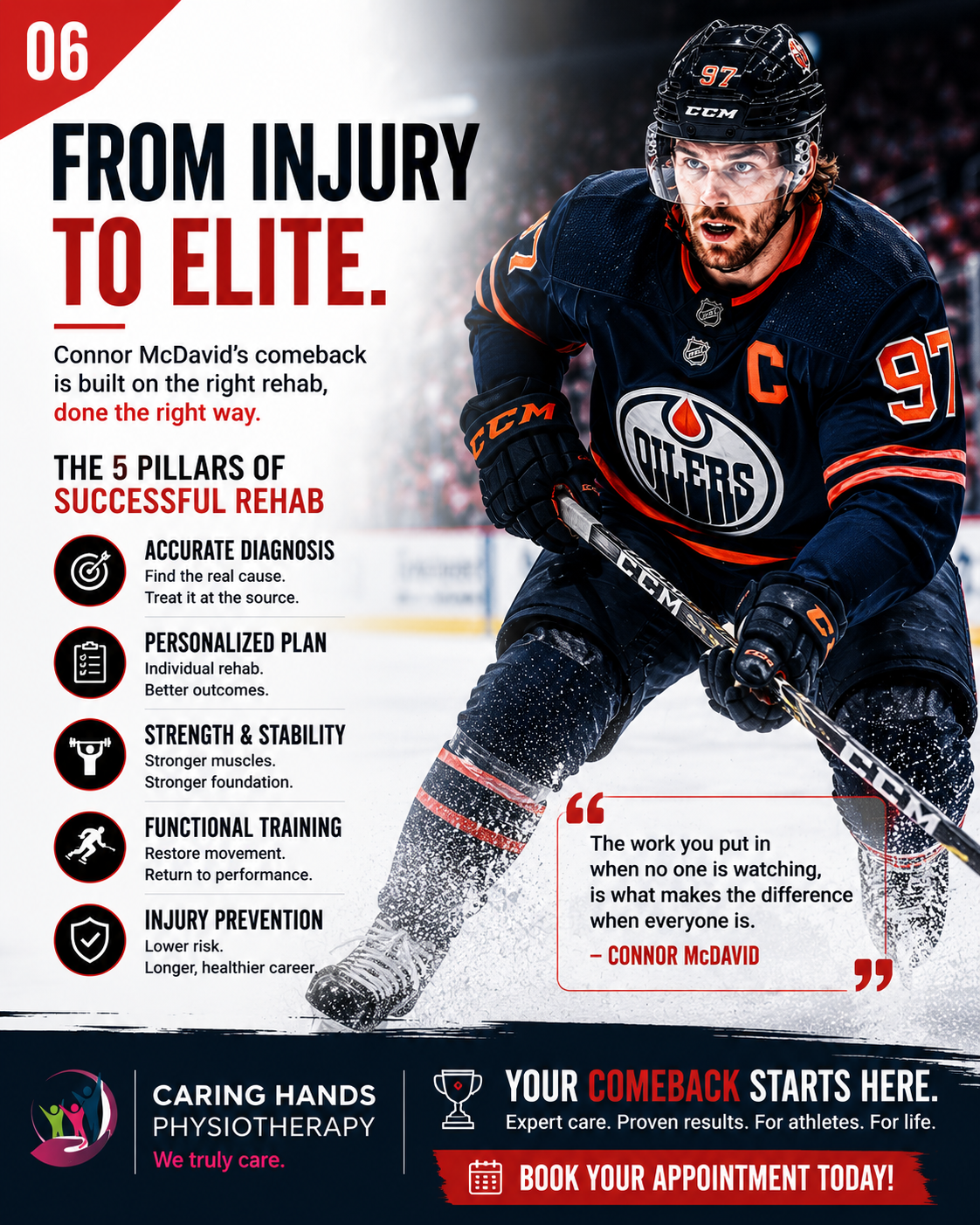

Why Connor McDavid’s Recovery Was Exceptional
One of the most important things to understand about Connor McDavid’s recovery is that outcomes like this are not typical.
Injuries involving a PCL tear and tibial plateau fracture can create long-term challenges involving:
For many athletes, recovery can take significant time — especially when attempting to return to explosive sports requiring speed, power, and rapid directional changes.
What made McDavid’s recovery remarkable was the combination of:
At the professional level, rehabilitation is not simply about becoming pain-free.
It is about restoring:
Elite athletes often spend hours each day focused on:
This level of consistency allows rehabilitation teams to carefully monitor:
In many cases, success depends not only on healing the injury itself, but also on restoring the athlete’s ability to move efficiently under high physical demand.
What Everyday Patients Can Learn From This
While most people are not training at an NHL level, many of the same recovery principles still apply to everyday injuries and active lifestyles.
Whether recovering from:
a structured recovery approach that combines movement therapy, strength progression, and recovery-focused care can often improve long-term outcomes.
At Caring Hands Physiotherapy, rehabilitation programs are designed to help patients restore:
through individualized treatment and evidence-based care.
Recover Smarter With the Right Rehabilitation Strategy
Connor McDavid’s recovery highlights the importance of structured rehabilitation, movement retraining, strength development, and recovery-focused care when managing serious injuries.
While every injury is different, the principles behind successful rehabilitation remain consistent:
Whether recovering from:
a properly guided rehabilitation plan can help improve both recovery outcomes and long-term movement quality.
At Caring Hands Physiotherapy, our team provides individualized treatment programs focused on:
to help patients return confidently to daily activity, work, sport, and performance.
Ready to Start Your Recovery?
 Physiotherapy Services
 https://www.caringhandsphysio.com/physiotherapy/
 Massage Therapy
https://www.caringhandsphysio.com/massage-therapy/
Massage Therapy
https://www.caringhandsphysio.com/massage-therapy/
 Sports Injury Rehabilitation
https://www.caringhandsphysio.com/sports-physical-therapy/
Sports Injury Rehabilitation
https://www.caringhandsphysio.com/sports-physical-therapy/
 Knee Pain Treatment
https://www.caringhandsphysio.com/hip-and-knee-pain/
Knee Pain Treatment
https://www.caringhandsphysio.com/hip-and-knee-pain/
 Sports Physiotherapy
https://www.caringhandsphysio.com/sports-physical-therapy/
Sports Physiotherapy
https://www.caringhandsphysio.com/sports-physical-therapy/
 Country Hills Clinic
https://www.caringhandsphysio.com/physiotherapy-in-country-hills-landing/
Country Hills Clinic
https://www.caringhandsphysio.com/physiotherapy-in-country-hills-landing/
Beddington Clinic
https://www.caringhandsphysio.com/physiotherapy-in-beddington/
Falconridge Clinic
https://www.caringhandsphysio.com/physiotherapy-in-falconridge/